Takes and trash talk from both ALL sides of the NHL's most obscure PATHETIC* rivalry

* Thanks, Kevin Lowe!

Showing posts with label Rob Niedermayer. Show all posts

Tuesday, November 04, 2008

Would you rather?

So here's what happened, best as I can piece together.

Brian Boyle smashes Rob Niedermayer into the sideboards. Travis Moen skates in to hit Boyle, but is quickly pulled aside by Tom Preissing. Niedermayer comes up swinging, but is wrestled down to the ice by Boyle. Your typical BoC get-together.

Here's the announcer: "Anaheim penalties to #32 Travis Moen, two minutes for roughing. #44 Rob Niedermayer a double minor, four minutes for roughing. Los Angeles penalty to #22 Brian Boyle, two minutes for roughing. Anaheim has the option of playing two men short for two minutes, or one man short for four minutes."

First question: Has anyone ever heard of a coach given an option of how they'd prefer to serve their team's penalties before? Is that even textbook legal, or just something that sort of got slipped in the heat of game action?

But now that it's happened, here's question two: if you were a coach in that situation which option would you choose? Both seem likely to yield a goal, so I guess the question might be which is more liable to yield two goals? Randy Carlyle opted for the 4-minute 1-man-down option (which I think is the correct call the referee should have made), but what would you take as an overpenalized choose-your-own-adventure coach -- two minutes of 5-on-3 or four minutes of 5-on-4? Theoretical answers are welcome in the comments.

Monday, August 18, 2008

The Red Wings’ Biggest Rival: the Ducks? Here’s Five Reasons Why…

The Chief over at Abel to Yzerman has created a bit of a project to pass the summer dead time, trying to categorically determine who really represents Detroit’s best current rival. He starts his study with the Colorado Avalanche, the first of ten candidates, and scores them in six categories: Quality of Team, Hate Factor, Past Playoff Adventures, Blogger Quality, Regular Season Sadness Factor, and Miscellaneous. It’s a pretty decent set of criteria, and aside from Blogger Quality (Ducks bloggers are a bit shorthanded), Anaheim figures to score highly across the board.

Still, I think it’s worth writing up a case for the Ducks, though I should take a moment and clarify: in this post I am writing about the hatred of Red Wings fans, not who Ducks fans hate. Detroit’s rival search is much different from Anaheim’s, in that the Wings have been alone in the Central Division for so long that they need to their sights elsewhere. Go see Dan Wood for the Ducks rivalry question (bonus: my answer is in the first comment there)—we’ve still got plenty of options in the Pacific Division, with Detroit and Edmonton thrown in for fun.

Anyway, as promised, here's five reason why Wings fans should hate the web-footed ones, Five Guys Who Eliminated Detroit in their Last Two Playoff Meetings. Not many active NHLers can boast about eliminating the Red Wings in their last two tries, I think, and while this is by no means a complete list, I don’t think that it would get much longer with more research. It's a rare achievement, as Detroit has a 26-9 series record since the '94 lockout. Here's some Wing-killers, though:

1) J.S. Giguere: Really, this conversation should start and end with Jiggy and his 2003 upset sweep, but it’s worth talking about his 2007 series as well. In both series Giguere made just enough saves to win, but aside from that these series were quite different. Let’s take a look:

2003: I can’t stress enough how awesome the 2003 Wings were—hell, just look at their 12 forwards that postseason: Yzerman, Shanahan, Fedorov, Hull, Zetterberg, Datsyuk, Holmstrom, Robitaille, Larionov, Maltby, Draper, and McCarty. Heck, if they find a place for the Grind Line in the HHOF, this could end up being a list of eleven hall of famers plus Holmstrom. Sure enough, the Wings dominated play, outshooting the Mighty Ducks 171-120 in four-plus games (including a triple-OT and a single-OT). And yet, with all those snipers taking all those shots, they managed to score only six goals. Six. Goals. Giguere murdered in his playoff debut, sweeping the defending champs, which not only exorcised Anaheim’s playoff demons from the past (the Ducks were a combined 0-8 against Detroit in their first two postseasons), but also started a Cinderella run to the seventh game of the cup finals. And as impressive as Giguere’s later sweep of the Wild was (4 games, 1 GA), I really have to say that Minnesota represents his second-most impressive series of 2003. Giguere finished Round One with three first stars of the game and one second star. How sick is that?

2007: This was a different story completely, as the '07 Ducks were a much more formidable team in front of their netminder. Long gone were the days of getting murdered on the shot board, as were the days when Giguere had to be the unreal difference-maker. Still, the Red Wings were the top seed in the west, and were dominant especially on home ice and on special teams. Indeed, this was more a Goliath vs. Goliath battle than anything that had happened in 2003.

Giguere ended up with more saves in the four-game 2003 sweep than he made in the six-game 2007 win, and his save percentage wasn’t even in the same stratosphere (2003: .965, 2007: .908), but one thing that J.S. was able to duplicate against the Winged Wheel: overtime perfection. Combined, Giguere went to OT against the Wings four times, and four times he came away a winner. 46 Detroit OT shots. 46 Giguere OT saves.

2) Sammy Pahlsson: Another member of the 2003 and 2007 squads, Pahlsson remains the longest-serving Duck (his Anaheim debut was November 24, 2000, one day before Giguere’s) and of course has been my favorite player since well before this blog started. You want offense? Go buy a Selanne jersey. You want flash? Getzlaf is your guy. You want hard work, defensive positioning, and attention to detail? Welcome to the Pahlsson Party.

2003: In the first cup run, Pahlsson centered a line with 19-year-veteran Steve “Stumpy” Thomas and 19-year-old Stan “Cheesy” Chistov, which would prove to be a great source for secondary scoring throughout that playoff year. The Sammy line was a huge boost in the Detroit series, as that trio contributed 4 of Anaheim’s 10 goals scored in the series (including a really cheesy Cheesy goal in G3).

2007: By this time Sammy was the unquestioned shutdown center for the Ducks, on a “Nothing" Line with Travis Moen and Rob Niedermayer. It was a banner year for Pahlsson, who probably got robbed of both a Smythe and a Selke within weeks of each other, but as usual put up zero fuss. Against Detroit, he worked the most difficult minutes available against Zetterberg and Datsyuk, and even got the two split up in an attempt to escape the Swedish Shadow.

In each of Anaheim's long playoff years, Sammy ended up playing the defensive center position on my favorite line of the postseason. His point totals against Detroit weren't that stunning (5 points in 10 games), but he did finish each series a +2 while averaging more than 4.5 shorthanded minutes per game.

3) Rob Niedermayer: The last member of the “2003 and 2007” club, Rob also played a significant role in twice eliminating Detroit. In both years, he played wing on the shutdown line, but had surprisingly strong offensive numbers (well, at least for Rob) while playing against the Wings' best.

2003: In his first playoffs for the Ducks, Rob played on a shutdown line with Steve Rucchin and Mike Leclerc, and proved to be a really strong forechecker. I remember him being a fabulous "first man in" after a dumped puck; Rob's strength is really on the offensive boards. Rob got 3 assists in the 4 games, which in Rob terms is phenomenal. In his first 31 playoff games with the Panthers before 2003, Rob had 4 assists.

2007: While Rob’s biggest contribution to the post-lockout Ducks was probably being Scott’s brother, he was also a strong contributor on Pahlsson’s shutdown line, strong enough that the trio played together for all 103 games of that season/postseason. Rob scored 3 goals in the Wings series to lead the team, and even though one of them was an empty-netter, we'll see below the importance of being able to score on an empty net.

Despite his shut-down role, Rob’s actually had impressive points totals against the postseason Wings: in 10 games, he has scored 8 points (0.8 pts/gm). Over the rest of his Anaheim career, he has played 50 playoff games NOT against Detroit and scored 15 points (0.3 pts/gm). Of course, Rob has his drawbacks also – between the two series he played more than 18 minutes of power play time without being on the ice for a PPG-for, but that’s more of a bad-use-of-personnel issue than a knock on Rob.

4) Scott Niedermayer: With Scott, you have to go way back in the time machine to look at his first time eliminating Detroit – he was a third-year player playing in his first cup finals for the New Jersey Devils. Still, Scott is another player who is 2-0 lifetime against the Winged Wheel, and while he might not inspire the same level of hatred as a Giguere or a Pronger, he’s scored some awfully kick-to-the-nuts goals against the postseason Wings.

1995: Ah, remember the days when lockouts would only last part of a season? At any rate, the 1995 cup finals featured Niedermayer’s Devils and the Detroit Red Wings, who at that point were 40 years removed from their most recent championship. Scott and the rest of the smothering Devils continued that drought, dropping the Wings in four straight. Though Claude Lemieux would end up taking home the Conn Smythe, Niedermayer had an impressive finals, with a highlight-reel, end-to-end goal and three assists in the four-game sweep.

2007: And if you think that ’95 goal was a back-breaker, Scott got even more clutch a dozen years (and 127 playoff games) later. He scored two goals in the six-game ’07 WCF, and both turned out to be huge. Game Two in Detroit he scored the game-winner from down low in the 15th minute of overtime to tie the series at 1 game apiece (assists to Rob & Sammy). Then, late in regulation of Game Five, with the Wings up by a goal and Giguere pulled for a 6-on-4, Scott delivered the "kick to the groin": a weak shot that deflected off the stick of Nick Lidstrom and fluttered lazily over Hasek’s shoulder (1:15 into this video). That shot, more than anything, decided that coin-flip series in Anaheim’s favor, and was probably the strongest case for Niedermayer’s Conn Smythe win.

The craziest thing about Scott’s tendency for huge goals is that the guy is pretty mediocre at shooting pucks. He’s nowhere near Pronger or Lidstrom in this regard. Still, there’s a lot of benefit having a full-time rover, and sometimes his weak-sauce shot is exactly what is needed to disrupt a goalie’s rhythm. Scott might not be as despised by Wings fans like Giguere or Pronger, but it’s tough to argue the importance of the goals he’s scored.

5) Chris Pronger: Ah yes, Sasquatch (as they call him). Pronger is the only member on this list to ever get eliminated by the Red Wings (four times on the Blues, I believe), but he’s certainly had his comeuppance since the lockout. In fact, one could make a claim that one of the biggest differences between Detroit’s 2008 cup run from the two previous attempts was that this time they didn’t have to go through Pronger. Or his elbows.

2006: Pronger was a monster for the Oilers in ’06, as the Red Wings would learn early and the Ducks would find out two rounds later. He scored seven points in the six-game Detroit series and ended the series a +4. That began a 2003-like run for the 8th-seeded Oilers, who proceeded to eliminate the Sharks and the Ducks before bowing out in their own SCF G7. Pronger finished Round One with three first stars of the game and one second star. How sick is that?

2007: Pronger was much more muted offensively in the ’07 WCF, only recording three assists in five games played, but his defensive numbers more than made up for that. In the '07 series, Detroit didn't score a single even-strength or power-play goal while Pronger was on the ice. While that’s impressive enough, I doubt that’s what Red Wings fans remember most.


Get off my elbow, Homer.

There’s a real case to be made that Pronger was the best player in both the 2006 and 2007 playoffs. Except for the technicalities that in 2006 he was a cup-loser and in 2007 he was suspended twice, he could have been the first back-to-back Conn Smyther since Mario Lemieux. Against the Wings both those years, he scored 10 points in 11 games and was on the ice for 20 GF, 10 GA, all while averaging more than 32 minutes per game. And despite his reputation, against the Wings he only had eight minors (somehow Rob Niedermayer went to the box for five minutes after this play).


The Two-Time Wing Killers. Can they make it Three?

I know this piece got awfully long and if you’re still with me, congrats. Still, I think it was worth going through the stories of these two-time Wing-killers, because there doesn’t seem to be a lot of players who have such streaks going (the only other one I could come up with in very limited research is Sandis Ozolinsh, who eliminated the Wings in his last three meetings – ’99, ’00, and ’03).

Combined, these five Ducks players made huge contributions in eliminating the Wings in ’95, ’03, ’06, and ’07, and it’s not a huge stretch to think if they hadn’t, Detroit might have won as many as four additional Stanley Cups by now. And really, who wants to live in that alternate reality? (Wings fans are insufferable enough as is.)

There's still plenty of other reasons for Wings fans to hate the Ducks (I didn't even mention the yappy mouth of Corey Perry), but I think this fivesome might prove as strong a rivalry argument as any. I'm hopeful that Detroit fans found this post as angering to read as I found it pleasing to write, because you know what that means. They'll be licking their lips for the next matchup, their chance for postseason revenge.

Welcome to the rivalry, Wings fans. Go Ducks.

Tuesday, June 17, 2008

"Oh Captain My Captain" Time For Change In the Ducks Locker Room


By Ken Armer,

Hey readers of BoC, yep, I'm the new Duck in town, and happy to be here. I just flew in from Texas and man are my arms tired. Ok, now i know how letterman feels...anyway. Yes, I reside in Texas, and yes, I'm a reformed Stars fan. I grew up watching the Stars. But as i grew older i stopped following them, and hockey. Once i got back into hockey, the Ducks became my team. Some may say I'm a Stars fan in Duck feathers, but ill show you your wrong by fall. Although, it may hurt my argument about proving some wrong to make my first post a complaint about the Ducks, i feel many will agree...even Earl and my California writing counterparts. So here goes nothing...

As a highly educated hockey fan, writer and former player, I think I have the right once in a while on certain issues to complain.

My past complaints have been about the trade of Andy McDonald for Doug Weight and a draft pick, and the Ducks early exit from the 2008 playoffs. Now I feel compelled to make it somewhat more personal.

Some may hate me for my opinion, but I feel hockey fans who are for improvement in the Ducks will agree with me. Anyway, on to the point at hand...

Chris Pronger is nowhere near new to being a leader in the Ducks organization, or any other for that matter. He is a fantastic blue liner and a pivotal D-man for the Ducks. His behavior of late though has risen my, along with some others, eyebrows—including the NHL’s.

The latest was a stomp on Canucks Center Ryan Kesler. I watched the video, and having played the game there is no way that was an accident. I would like to believe it was, but come on.

More than just this minor misstep, literally. Chris Pronger has been suspended seven times in his 14-year career. That’s a lot for the captain of a hockey team. Too many if you ask me.

When the Ducks won the Cup in 2007, Pronger found himself suspended twice during that playoff run. Sure, he was not the captain then, but is a guy who makes this many poor choices in two seasons worth being your influential leader and voice between the bench and the zebra (ref)?

Pronger is a leader when he is using the entirety of his brain and not flying off the handle making poor choices. In the last two seasons though, things have gotten out of hand. By this point, some readers are thinking “Well, since he’s so bad who should be captain?”

My pick would be for Rob Niedermayer, the grinding forward who, even with his age, experience, and his placement in the lineup, is a constant force in all aspects of the game.

If the Ducks need someone on the defense in a leadership role, why not give an “A” to Sean O'Donnell or Mathieu Schneider. Pronger can be a leader without a letter on his sweater and he shouldn’t have one until he can better control his behavior.

I don’t honestly expect a change to be made, but I truly think Rob deserves a chance, more than just an “A” on his sweater. He deserves the promotion and even more he fills the role like it is supposed to be filled.

Look at Patrick Marleau. He hardly ever does something stupid and he’s a positive influence for the Sharks.

Brenden Morrow for the Stars is the same deal, an emotional force that leads his team by example, both in the physical game and scoring game, winning goals to lead his team to the Conference Finals. While Pronger’s example is to stomp on guys and elbow them to gain a suspension from the NHL.

As some will have noticed, I skipped over Scott Niedermayer and Teemu Selanne, who although are leaders, need to let someone with a longer future with the Ducks take the role.

Selanne or Scotty would be fantastic captains, but until they decide on their futures in hockey, they need to focus on other things rather than being the emotional leaders. They fill those roles without the sweater designation.

If Pronger does keep the “C,” I hope his behavior will improve so he will be a leader and not a distraction.

Emotion on the ice is a powerful thing, but Pronger is like a tea kettle—he boils over too often. If his teammates truly feel he is the captain they need then so be it, but maybe they should really think about a change for the 2008-2009 season.

Wednesday, December 05, 2007

Earl answers his mail: Forward Lines, a year-to-year comparison

Sleek,

The Ducks play so far has me frustrated. And you seem like the guy to help explain the frustration. I'm curious about ES TOI this year versus last year for the Duck's containment line. As yourself, I'm a huge fan of Pahlsson, but it seems like that line is getting more ES TOI this year. Could just be my imagination.

However, if it's true, then it might explain some of the drop off in scoring. And also point to a coaching phylosophy that needs to change. The Ducks need to dictate play, rather than react (by over-using the containment line).
Keep up the great work on the blog.

Jeremy
I'm a sucker for flattery, and yeah, I do have been keeping some spreadsheets for this sort of question, so without further ado, let's take a look at the forward lines for Anaheim, this year compared to last year. In a lazy move, I'm just using screen captures of Excel tables; hopefully they are all legible.

For the Ducks, it really makes sense to compare forwards by their on-ice responsibility, because I think context matters a great deal in Carlyle's strategy. The Ducks play a top scoring line against the opposition's top defenders, a stopper line against the opposition's top scorers, and a sheltered line that for the most part doesn't carry either responsibility. The tables below are meant to reflect that, and show each line's even-strength minutes per game, even-strength points per 60 minutes, and even-strength goal-differential per 60 minutes. I'll try to indicate numbers that stand out to me after each table.

The Top Line:
With the departure of Teemu Selanne, the top line minutes this year have gone to the kids--Getzlaf and Perry. In terms of even-strength TOI, it seems the top line is playing more than it did last year. The thing about this year's top line is that while their point production seems adequate when compared against last year, this year's version bleeds goals-against at a higher level than Selanne's line ever did. It's a fair concern, as it does put a lot of the burden of outscoring onto the other lines.

The Stopper Line:
Unlike the other lines in this analysis, the stopper line continues this year without any change in personnel. In terms of Jeremy's question, we can note that the even-strength minutes-per-game have increased, and also noticeable is that the stopper line is scoring at a lower rate than they were last year. Even so, the rate at which the line gets outscored (quite a reasonable outcome considering the difficulty of minutes) hasn't changed a whole lot--the stopper line is still contributing like they did last year, though with a lower offensive output.

The Shelter Line:
This is where things get a little shady, as this "second line" personnel has been fairly shifty this year, and even Dustin Penner last year wasn't a full-time member of the Getzlaf line. Still, this gives a sense of who's getting the easier minutes on the team and what's being done with them. A big reason for last year's success can be pinned on the fact that Getzlaf and Perry were able to dominate these minutes, something that McDonald and Bertuzzi, in particular, seem unable to do. These players, too, seem to have picked up some minutes-per-game, something we've seen on every line thus far.

A quick look at special teams:
Here are each year's top minute-men on the power play and on the penalty kill. The power play scoring rates are obviously lower this year than last year, and a lot of that can be pinned on the 2nd unit's personnel--giving Mark Mowers and Rob Niedermayer power play time isn't in any winning coach's strategy book. Going by minutes, it seems that the Ducks have less power play time per game than last year, which probably correlates to the additional even-strength ice time we've seen on every line.

As for the penalty kill, the top pairing of Pahlsson and Rob Niedermayer seem to be as effective as last year, but the secondary unit of Marchant and Moen has seen a steep drop-off in goal prevention.

Conclusions:

I think this analysis has been useful in seeing which minutes, in particular, seem to be preventing the Ducks from experiencing success similar to last year's. The problems that I can see are that the shelter line isn't finding a way to outscore soft competition, the top line is allowing more goals-against, and the stopper line could score some more goals. However, on an overall level I can't say that overplaying the Pahlsson line looks to be the Ducks' problem--that line, at least, has differential rates similar enough to last year.

Really, though, the Ducks' problem isn't really one that's explained through the forward minutes, I think. Certainly there are effects that come from personnel changes, but I think what's causing the dropoff more is the lack of a second Norris defenseman; last year these lines either had the benefit of usually a Pronger or a Niedermayer on their blueline, but nowadays Pronger minutes can only be distributed so far (usually in a defensive setting, as nobody else is really trustworthy).

The Ducks' movie theme thus far.

I have no idea what sort of team the Ducks would become if or when Scott Niedermayer rejoins the team, but I gotta think that a lot of these issues could be compensated by a blueline that's better at retrieving the puck and creating offense through transition. In that regard, TSN's Bob McKenzie has fantastic news for Ducks fans; Scott may be returning to the roster very soon.

If that happens, I'll gladly re-run these numbers after several games to see what effect another Norris defender has on the forward minutes. I'm not sure it can get back to last year's numbers, but I'll be happy for any improvement to what's become a rather mediocre team. In the meantime, I'll probably throw another post up pretty soon to show the defenseman minutes, where the Ducks' year-to-year dropoff will probably be more apparent.

Thanks for the question, Jeremy. As always, Go Ducks.

Thursday, October 25, 2007

Ducks Gameday—Puttin' square pegs into round holes

Phoenix Coyotes (2-5-0, t-14th in west) at Anaheim Ducks (4-6-1, t-9th in west)

Missing Players by Game

(includes games where a player was unavailable to finish the game)

Well, it hasn't been the best start to the season for the champion Ducks, who between travel and injury have been reduced for the most part to a rather mediocre squad. I'm still unsure how a fully-iced Ducks squad figures to perform this year, and from the sounds of things, I don't think I'll be finding out anytime soon.

Since Bertuzzi went down early in the Minnesota game, though, it's been especially thin for the Anaheim power play. Coach Carlyle in the face of a limited roster has been loading up talent on the first power play unit, but then filling the second unit with his penalty killing personnel. The table below shows five players who, despite not playing hardly any power play time last season, have put in some serious PP minutes the last six games.

The New Power Players

Rob
Niedermayer

Mark
Mowers

Travis
Moen

Sammy
Pahlsson

Todd
Marchant

Games Played Last Year

82

78

82

82

56

Total PP TOI Last Year

15:40

15:04

13:52

13:16

8:01

Avg PP TOI Last Year

0:11

0:11

0:10

0:09

0:08

Games Played Last 6 gms

5

5

6

6

4

Total PP TOI Last 6 gms

18:18

17:24

3:40

4:26

3:18

Avg PP TOI Last 6 gms

3:40

3:29

0:37

0:44

0:50

Pct Increase from LY Avg

1916%

1802%

361%

457%

576%

Season High PP TOI

6:13

4:55

2:34

2:34

2:26

Pct Increase from LY Avg

3254%

2545%

1518%

1586%

1700%


Thus far the five have combined for one power play assist (Sammy, of course), but I'm not going to knock their efforts; it's really not their gig. Anaheim's checking forwards are a special bunch, for sure, but their contributions aren't really on the ANA portion of the scoreboard. The fact that these checkers are getting such decent power play time really begs the question, though: why isn't Bobby Ryan cracking the lineup right now, even for an emergency special-teams-only engagement? Those are minutes where an offensive player could make an impact and prevent Anaheim's penalty-killers from being exhausted from unproductive power play time.

The checking line just aren't suited to be power play personnel, no matter how much ice time Carlyle insists on giving them. He may as well glue nail clippings to his lip and wait until it becomes a moustache.

Anyways, Phoenix is in town tonight for the first of eight on the season, and I'm not quite sure if that's a good thing. Since the lockout, the Ducks have used the Desert Dogs as a steady source of standings points; in sixteen games the Ducks are a whopping 13-2-1. A huge factor here is that in those 16 games, the Ducks' power play has produced 23 goals while the Coyotes' power play has produced only 8. The two points seem attainable enough, but with Anaheim's decidedly mediocre power play and overall sketchy lineup, it's not nearly as in the bag as it could be. (For the 'Yote angle, check out PB's take at One Fan's Perspective.)

Still, I've managed to come up with a saying that's annoyingly helpful in putting it all in perspective. As discouraging as the first eleven games of the 07-08 season have been, it's still the best twelve game stretch in team history (counting the last game last year, of course). Complacency will be the death of me, I guess.

Prediction: Phoenix donates two points to Anaheim's playoff drive yet again; Ducks 5, Coyotes 2. Goals by King, Wirtanen, Perry, Hnidy, and an ill-advised PPG by Pahlsson.

Go Ducks.

Tuesday, October 16, 2007

The London Effect: Putting the “UK” back in “SUCK”

Well, it’s been a combined 10 games played since the Ducks and Kings split games in London, and of course results have been less than stellar: combined only two of those games have resulted in BoC wins, and both those wins came midway through the third period. Combined, the teams have been outscored 11-8 in the first period, 19-13 in the second period, and 19-14 in the third.


Now of course each of these teams has some issues outside of the London travel: the Ducks have been playing with an injury-compromised roster since day one, and the Kings are still trying to figure out how to work with their new lineup, from the net on out. But still, I think it’s clear that there is more going on here than bad rosters—between the shortened training camps and the intercontinental travel, King and Duck results have been adversely affected by the bizarre start to the season.

As things continue to settle, I think we’ll get a better idea of what we can blame on London and what we can blame on actual roster deficiency, but I think the warning is clear. Next year the NHL has announced opening the season in Prague—so far the Lightning, Penguins, and Senators have been mentioned as possible ambassadors. If I’m any of those teams, I’d take a hard look at how the Ducks and Kings struggled after their returns to North America; so far the evidence shows that starting overseas is a huge early hurdle to overcome, especially for teams coming in with roster issues.
-----------------------------

Interesting stat from last night’s game: The Ducks scored a 6-on-5, a 5-on-3, a 5-on-4, a 4-on-4, a 4-on-5, and a 4-on-6 goal. Six different types of goals; none of them your basic 5-on-5. Of course, as the Chief points out, the refs had a field day yesterday: 5 hooks, 5 trips, 4 holds, 3 slashes, 3 unsportsmanlike conducts, and 1 each of crosschecking, elbowing, boarding, and interference (plus a delayed penalty that never got called). At this point, I’m hungry enough for the two points that I won’t complain too much about refereeing, but I don’t find it exciting or compelling when a 60 minute game is reduced to only 25 minutes of 5-on-5.

The Ducks’ power play is pretty intriguing right now, though, especially with the depleted roster. In the last two games, the PP has gone 2-for-19 in nearly 29 minutes of PP time. While that may not impress anyone, I actually think it’s been a decent number for the Ducks when considering who’s been playing on their second unit. Over the last two games, Rob Niedermayer has played 10:02 and Mark Mowers has played 9:46 of power play time, predictably with no goals scored. To compare, last year in 82 games with the Ducks Rob Niedermayer totaled 15:04 of power play time and in 78 games with the Bruins Mark Mowers totaled 15:40 of power play time. In that ice time, they combined for one power play assist. I really have no idea why they are meriting the ice time lately (other than I guess there’s no good candidates to fill the forward minutes), but it seems like Carlyle is comfortable throwing away the man-advantage time.

The real boost, though, has been on the other end of special teams with the return of Sammy Pahlsson and his fabulous PK. In three games since his return, Sammy has played nearly 13 ½ minutes of shorthanded time, in which the Ducks have scored two goals-for and allowed zero goals-against, including Pahlsson’s game-winning shortie last night. Overall this year, the Ducks have killed penalties at a 73.5% clip without Sammy in the lineup and a 93.8% with Sammy. While the London Effect certainly affects this discrepancy somewhat, the fact remains:

Sammy is god.

Tuesday, September 11, 2007

Scott, you lazy genius!

Dear Scott: I for one would like to say that I completely support your inability to make up your mind. Sure, retirement would have meant you could relax away from hockey, but not deciding, now there's a stroke of brilliance!

Not only do you avoid pesky hockey duties like training camp and flying to London and back, but you also get to steer clear of any PTAs or HOAs or any other serious household responsibilities. After all, how could you commit to anything long-term? You've still gotta remain available for hockey, just in case you stumble on some motivation or conscience, right?

One lazy guy to another, I salute you, soldier. You've played enough games hurt that I can allow some missed games healthy. Enjoy your break.

(Oh, and Scott? Just in case you're looking for some non-paying employment to occupy your free time for a bit, don't forget we're always on the lookout for more Conn Smythe winning writers here at BoC!)

-----------------------

Aside to the fans: I've heard lots of grumbling that Scott is holding the Ducks hostage with his indecision, and sure there's $6.75 M of salary sitting in limbo, but I'm not worried. Brian Burke has kept the cap space available for a return, and can surely he can find a way to motivate Scott to play, if things get desperate.

Don't forget that he has one key bargaining chip at his disposal:


Scott, if you ever want to see Rob's famous
backhand again, you'll rejoin the team ASAP.

See ya soon! -- B. B.

p.s. A very happy birthday to our blogdaddy, the ever-awesome Battle of Alberta. So many awesome posts, but I just gotta link to two of my personal faves: Beard Talk and its sequel The Many Faces of Sacamano. Great work, guys.

Saturday, May 05, 2007

“I’ve never wanted to smell like Pine-Sol so bad in my life!”

Here's a fun link for your playoff Saturday: Tonight Show comedian Harland Williams makes a Duck Call special, chronicling his day with the Anaheim Ducks.

Among the highlights:

  • Rob Niedermayer gets to challenge someone for having less hockey skill than he does.
  • Ilya Bryzgalov makes a pad save and gets fussy over his equipment.
  • George Parros learns a new fighting tactic.
  • Scott Niedermayer's children hate each other.
It's always nice to see NHL players let down their guard and show some actual personality--much better than using them as shower props to remind us that hockey is back. So check it out, and leave your favorite moment in the comments.

Happy Cinco, everyone!

Thursday, April 26, 2007

The view from my playoff seat

(Author's warning: I absolutely suck at photography, and where I sit, pretty much everything gets shot through a pane of glass. It is pretty evident that my autofocus camera decides that it would rather focus on the glass than the people behind it, but I really do not have the know-how or the sobriety to fix it; my solution is really just to point-and-shoot some more. I apologize these pics aren't better, but you should see the ones that did not make the cut!)

(Alternatively, you might just say that this is my perspective as I got progressively drunker throughout the game.)

Here's a real rarity, both Rob Niedermayer and Sammy Pahlsson sitting side by side in the box, begging the question, "Oh crap, who's going to kill this penalty?"

This was early in the first period, and the lady sitting next to me (between myself and the box) really thought I was nuts, between the "Go get 'em Sammy!" yells and me trying repeatedly to get a half-decent photo (turns out the best I could get was a quarter-decent shot).

After they served their time and I put the camera back in my pocket she sighs in the way only an O.C. woman can, and mutters, "You act like you've never been here before."

My only reply? "Well, I never bring my camera here; usually it's just drinking and yelling." It's too difficult to quickly explain and justify a man-crush to a woman that disgusted.

Teemu Selanne in the second period, after his unsportsmanlike penalty. For some reason, I get to see Selanne in the box a lot, and most of the time it is stuff like diving or even his illegal stick. I always try to yell some words of encouragement in there, because really, who likes a depressed Finn?

Selanne is probably the only player who does any sort of acknowledgement to the crowd, though it sometimes isn't more than a quirky eyebrow raise, as if to say, "Who knew that they would call THAT in this day and age?" I always try to control my eyebrows so they don't send the message, "I knew."

Chris Pronger in the box. I never got a really great shot of him (a common theme here), but I was pretty excited to have him there. Despite sitting in these seats six times this year, Pronger had never ever EVER come to visit. It was kind of depressing, really, because I saw him take plenty of penalties on TV.

Is it me, Chris? Is a trade demand imminent?

OK, by now you can see that I am extremely untalented, but to prove it here's Andy McDonald parading around at warp speed as the first star of the game, not in the least bit considerate of us new photo-bloggers who can't seem to focus on anything but the glass in front of them. It occurred to me on my way home that tonight was the second time I had ever thrown a hat on the ice at an NHL contest, and both times it followed a McDonald goal against Vancouver (though this was the first time I actually threw it for an actual hat trick).

Flash back to preseason 2005, immediately following the lockout. In lockout-starved eagerness, I snagged Row B tickets to one of the first preseason games the Ducks played, against the Canucks. Recall, if you will, the format of those first preseason games: no matter the outcome of the game, they would still stage a shootout afterwards (even in non-tie situations). Well, we had lost the game 3-1, and were on our way to also losing that shootout, but Andy Mac managed to score one against Dan Cloutier, and just out of post-lockout excitement (and disbelief that we could lose a game and a shootout), I threw my hat on the ice.

Did I mention that I was drinking that night also?

Any way, there were still four or five shooters left, and the refs noted that there was a hat there sitting awkwardly by the penalty boxes. But they kind of looked at each other and shrugged; after all, it wasn't in the way of anything. All they needed for a shootout was the center stripe. So it sat there, uncomfortably, until the shootout had ended.

I was kind of proud of myself, though. I rationalized, hey, that's the first hat that's been thrown in a year-and-a-half. Welcome back, NHL.

(Think you are better than me at photographing from your playoff seat? Prove it! E-mail your best shots to japers.rink.photos@gmail.com)

Tuesday, April 24, 2007

ANA / MIN review: Forget the Selke, let’s give Pahlsson the Smythe!

With round two starting tomorrow, I doubt I’ll have time to properly recap the first round victory over the Wild (yet another instance of California dominating Minnesota), but I do want to take a stab at answering the question of who the real stars of the series were. To be fair, you can make a case for a lot of Anaheim players here:

  • Ilja Bryzgalov, for admirably stepping in on zero notice for G1 and playing well enough to start the next three games;
  • Getzlaf, Perry, and Penner, who combined for three of the four game-winners in the series;
  • Chris Pronger, who led the team in ice time (142 minutes) and scoring (2-4-6);
  • or even the d-pair of Niedermayer and Beauchemin, who played big roles in shutting down the Wild’s offense.
But digging deep into the round one numbers, I gotta say the heroes of round one were definitely the stopper line of Sammy Pahlsson, Rob Niedermayer, and Travis Moen.

You see, there’s two things to keep track of when trying to evaluate the performance of a line: the first obvious one is production, both in goals-for and goals-against. Most people do alright in eyeballing those ‘counting’ stats, and can see who is producing and preventing goals. The second is trickier, but probably just as important, and that is context: who are lines playing against, and what the expected outcome from such a match-up?

From LCS Hockey’s ANA-MIN series rundown:
Hey, maybe this is the postseason people start noticing that Samuel Pahlsson is one of the top two or three defensive forwards in hockey. Not only did Sammy play a big role in containing Marian Gaborik and Pavol Demitra, he also chipped in three assists.
This line was unbelievable in round one, totaling 2 goals and 5 assists while frustrating the hell out of the Wild’s dual Slovak threat. (Selanne / McDonald / Kunitz, by comparison, totaled 2 goals and 1 assist in the series, while playing against much less productive players).

Pahlsson in particular was a standout. Using IOF’s H2H ice time site, Pahlsson was on the ice for 63% of Gaborik’s 5-on-5 ice time and 64% of Demitra’s. In addition to that impressive even-strength duty, he also led all Ducks in penalty-killing time (27:35, 55% of Anaheim’s total shorthanded time), in which the Wild managed to score zero PP goals. Remember, the Wild had the sixth-best power play in the league over the course of the regular season.

In the 5-game series, Sammy led all Ducks with 16 hits (twice as much as any of his teammates) and 58 faceoff wins (27 more than any of his teammates). And hell, even when Coach Carlyle ran out of players to put on his power play in a penalty-heavy G2, he threw Sammy, Rob, and Travis out and they managed to produce a faceoff goal almost immediately.

In terms of goal-differential, Pahlsson in the series was on the ice for 4 goals-for, and only 2 goals-against (all situations). Considering the opposition he had to go against was generally the Wild’s top line or even worse, their power play, those are astounding numbers. No wonder Coach Carlyle hasn’t split this line up in any one of the 87 games to-date (an unbelievable stat for that trio, really—zero games missed to injury and zero games split up in line-shuffling).

Go get ‘em, Sammy & friends!

Tuesday, November 28, 2006

An Open Letter to Edmonton Fans

(SPECIAL GUEST COLUMNIST: ROB NIEDERMAYER!)

A special thanks to Earl Sleek for allowing me this opportunity to address hardcore Oiler fans.

My name is Rob Niedermayer, sometimes called "RNieds", or "the other Niedermayer". You might remember me from the last western conference finals, although you probably had to be paying pretty good attention to notice little old me.

At any rate, I am not here to chastise the Edmonton faithful for feeling betrayed by last offseason’s mysterious Pronger departure, nor even to try to plead for a well-behaved Rexall crowd tonight. I remember when I was traded how hard it was on my fans, when later they learned that I was actually Scott Niedermayer’s brother.

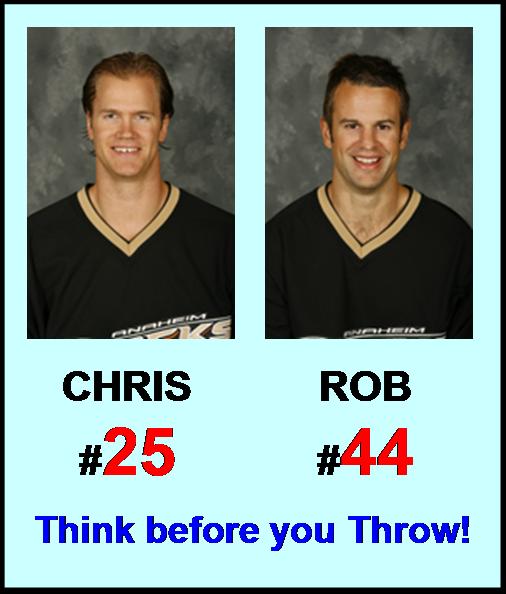
No, I am writing today to emphasize a fact that I’m not sure has gotten enough publicity in the Edmonton area: Chris Pronger no longer wears number 44. Because of my impressive stature on this Anaheim team (again, Scott’s brother), I was allowed to keep the number, and Prongs instead chose number 25.

This is very important tonight, as you are stuffing your socks with loonies and pulling batteries out of your iPods, THINK BEFORE YOU THROW! For now, and for the foreseeable future, #44 is not public enemy #1 in Edmonton; it would be a shame if a well-aimed beer toss got sent to the wrong recipient tonight.

Prediction: Ducks 5, Oilers 3. Despite my efforts, I still get hit by a misguided Pronger projectile.

Wednesday, November 08, 2006

The best two even-strength forward lines for the Ducks

One of the statistical inroads into hockey analysis, I think, has been segmentation of situational play. Here’s two lines that are killing at even-strength for the Ducks, which is a huge factor in their top-of-the-league record.

First off, there’s God himself, and his two buddies Rob and Travis. What is amazing about these ES outscoring rates is that this is the line that matches up against the opposition’s best. Basically, in a situation where they should find themselves outscored, they are dominating play.

Player

ES minutesES +/hrES -/hrES dif/hrES G-A-PtsES Pts/hr

Samuel Pahlsson

190

2.85

-0.95

1.90

2-5-7

2.22

Rob Niedermayer

193

2.80

-0.93

1.87

1-5-6

1.87

Travis Moen

175

2.74

-1.03

1.71

3-1-4

1.37


Secondly, there’s the kid line, who play in a much different setting than the Pahlsson line. These guys get the easiest minutes, but still, they are cashing in at a bloody rate. This line at ES pretty much scores 2 goals for every 1 it allows. Ironically, before Fedoruk got Boogarded out of the lineup, he led the team in both ES points-per-hour and ES pluses-per-hour. A shame we had to lose our best offensive star.

Player

ES minutesES +/hrES -/hrES dif/hrES G-A-PtsES Pts/hr

Corey Perry

121

3.97

-1.98

1.98

2-2-4

1.98

Ryan Getzlaf

125

3.86

-1.93

1.93

4-1-5

2.41

Todd Fedoruk

75

4.04

-2.43

1.62

0-3-3

2.43


The other two lines (centered by McDonald and Marchant) have been adequate at ES, pretty much scoring as much as they are being scored on. They are valuable lines still, as McDonald’s line is contributing well on a potent power play and Marchant is statistically one of our best penalty-killers. Also, I’m not sure how much credit to give to these specific players, as goaltending has been outstanding for the Ducks (which should help everyone), and Chris Pronger in particular looks to be an ES monster (1.62 ES dif/hr).

So be warned, future foes. You wanna beat the Ducks, you better start thinking about these two lines—specifically, how can we prevent getting killed by these two lines at even-strength?